In commercial fleet maintenance facilities and heavy-duty repair bays across North America, cutting wheel-end service time while managing operating expenses is a perpetual priority. However, one dangerous practice continues to undermine fleet safety and inflate Total Cost of Ownership (TCO): reusing worn wheel-end foundation hardware during routine brake shoe relines.
When a Class 7 or Class 8 tractor or trailer enters the bay with worn friction blocks, technicians frequently rivet new linings onto bare steel skeletons or hang fresh pre-lined brake shoes while leaving the existing return springs, anchor pins, and cam rollers in place.
Reusing foundation hardware might save a few dollars in immediate parts expense, but it represents one of the leading root causes of premature lining taper wear, persistent brake dragging, drum heat-checking, automatic slack adjuster stroke over-extension, and out-of-service violations during CVSA roadside inspections.
For commercial fleet directors, parts distributors, and shop managers, understanding the severe mechanical, thermal, and regulatory realities of wheel-end hardware replacement is essential to maintaining DOT safety thresholds and maximizing equipment uptime.
1. The Extreme Operating Environment of Foundation Drum Brakes
Commercial foundation drum brakes—such as the standard 16.5" x 7" setups found on Meritor Q-Plus, Dana Spicer, and Eaton platforms—operate under punishing physical constraints:
- Thermal Cycling Exceeding 750°F (400°C): During prolonged mountain grade descents, recurring intermodal yard stop-and-go runs, or severe-duty vocational cycles, continuous friction generates intense wheel-end heat. Foundation brake hardware components sit directly inside this closed, high-heat environment.
- Massive Mechanical Torque Under 20K–23K GAWR: Every time the s-cam rotates, air brake actuators exert high pneumatic clamping force, driving anchor pins, rollers, and shoe webs against the rotating drum under maximum Gross Axle Weight Ratings.
- Chemical Corrosion & Road De-Icers: Operating across North American winter corridors exposes wheel-end hardware to highway brine, calcium chloride, magnesium chloride, and road salt.
Hardware components undergo irreversible metallurgical changes across every reline cycle. Treating springs, pins, and rollers as "lifetime" parts ignores the physics of material fatigue.
2. Component-by-Component Failure Analysis
Extension Return Springs: Thermal Annealing and Tension Loss
Return springs are the mechanical force responsible for retracting brake shoes away from the brake drum surface the instant the driver releases the brake pedal.
The Problem: Commercial brake return springs are coiled from high-tensile spring steel subjected to precise oil quenching and tempering. Under continuous thermal cycling exceeding 750°F, the steel undergoes thermal relaxation and micro-structural annealing. Over a typical 100,000-to-200,000-mile operating cycle, an unreplaced return spring loses up to 30% to 50% of its initial elastic pull force.
The Consequence: A heat-fatigued return spring cannot pull the shoe assembly back against the s-cam quickly or completely. The friction lining remains in light, continuous contact with the rotating drum—a condition known as brake dragging. This causes:
- Constant friction glazing on newly installed lining blocks.
- Premature drum thermal checking and circumferential micro-cracking.
- Increased wheel-end drag, driving up diesel fuel consumption across the fleet.
S-Cam Rollers: Flat Spots, Grooving, and Binding
Positioned between the camshaft lobes and the brake shoe web pocket, case-hardened steel cam rollers transmit rotating cam torque into linear expansion force.
The Problem: Cam rollers must rotate freely on their axles to distribute mechanical wear evenly across their cylindrical surfaces. However, dirt intrusion, burnt lubrication, and continuous directional thrust frequently cause rollers to skid rather than roll against the s-cam head.
The Consequence: Once a roller sticks, the s-cam head grinds a distinct flat spot into the roller face.
- A flat-spotted roller alters the pivot geometry and changes the effective leverage ratio of the s-cam.
- It forces the automatic slack adjuster (ASA) to travel further to achieve proper drum contact, leading technicians to misdiagnose excessive pushrod stroke as an ASA failure.
- It creates asymmetric actuation force, pushing the top or bottom shoe unevenly and causing severe lining taper wear (where the cam end wears out while the anchor end remains untouched).
Anchor Pins & Bushings: Wear Pitting, Play, and Shoe Twisting
Anchor pins and their corresponding retaining clips/bushings provide the fixed pivot point for the shoe heel.
The Problem: As heavy braking force pushes the shoe heels outward against the anchor pins, unhardened or corroded pins suffer severe surface grooving, galling, and ovalization of the mounting bores.
The Consequence: Excessive play at the anchor pin allows the brake shoe skeleton to twist off its vertical axis under heavy braking loads. This causes:
- Edge-pinching and diagonal friction wear patterns across the shoe table.
- Localized hot spots and vibration chatter.
- In severe cases, the shoe web can catch or bind in the anchor pocket, delaying release or preventing full emergency application.
3. The True Cost of Reusing Hardware: A Fleet TCO Perspective
Skipping hardware replacement is a false economy. The math demonstrates why leading fleet maintenance programs enforce mandatory hardware replacement:
| Metric |
Scenario A: Reusing Old Hardware |
Scenario B: Complete Hardware Replacement |
| Initial Hardware Cost per Wheel-End |
$0.00 |
$12.00 – $25.00
|
| Average Friction Lining Service Life |
120,000 – 160,000 Miles (Degraded by drag & taper)
|
250,000 – 350,000+ Miles (Uniform wear profile)
|
| Brake Drum Replacement Frequency |
Every 1–2 Relines (Due to heat checking & glazing)
|
Every 3–4 Relines (Smooth, controlled friction sweep)
|
| Roadside DOT Inspection Risk |
High (Excessive stroke, dragging, out-of-service)
|
Minimal (Optimal stroke & instantaneous release)
|
| Unscheduled Roadside Downtime Cost |
$1,200 – $3,500+ (Towing, fines, roadside tech rates) |
$0.00 (Reliable preventative maintenance cycles) |
Replacing hardware during every reline directly protects the fleet's investment in premium friction blocks and high-dollar brake drums.
4. Universal vs. Dedicated Hardware Kits: What Commercial Buyers Should Know
To optimize stock turnover and prevent installation errors, parts distributors and fleet parts rooms must match hardware configurations to foundation architecture:
- Q / Q-Plus Foundation Kits (e.g., 4707 Repair Kit): Tailored for dual-anchor Meritor-style geometries (4515Q, 4707Q, 4711Q, 4705). These multi-compatible master kits bundle heavy-duty oil-tempered return springs, induction-hardened rollers, and quick-change retention clips. Stocking multi-fit sets streamlines warehouse SKUs while covering the majority of North American tractor and trailer axles.
- Single-Anchor Pin Kits (e.g., 1308E / 4515E Repair Kits): Engineered specifically for Eaton-style foundations featuring open anchor slots and center-mounted retention spring clips. Attempting to cross-fit Q-style hardware onto single-anchor shoes results in immediate mechanical failure.
- Specialized Profiles (e.g., 4709, 4720, SAF SK9, BPW Kits): Tailored for specific web contours, steer axle requirements (such as 4720 16.5" x 5" configurations), or specialized European-spec intermodal running gear.
5. The Ultimate Fleet Best Practice: Boxed Brake Shoe Kits
The heavy-duty commercial aftermarket has increasingly moved away from sourcing unlined cores, loose friction blocks, and separate hardware bags. Commercial fleets and independent repair facilities overwhelmingly favor pre-assembled, lined Brake Shoe Box Kits.
A turn-key box kit delivers:
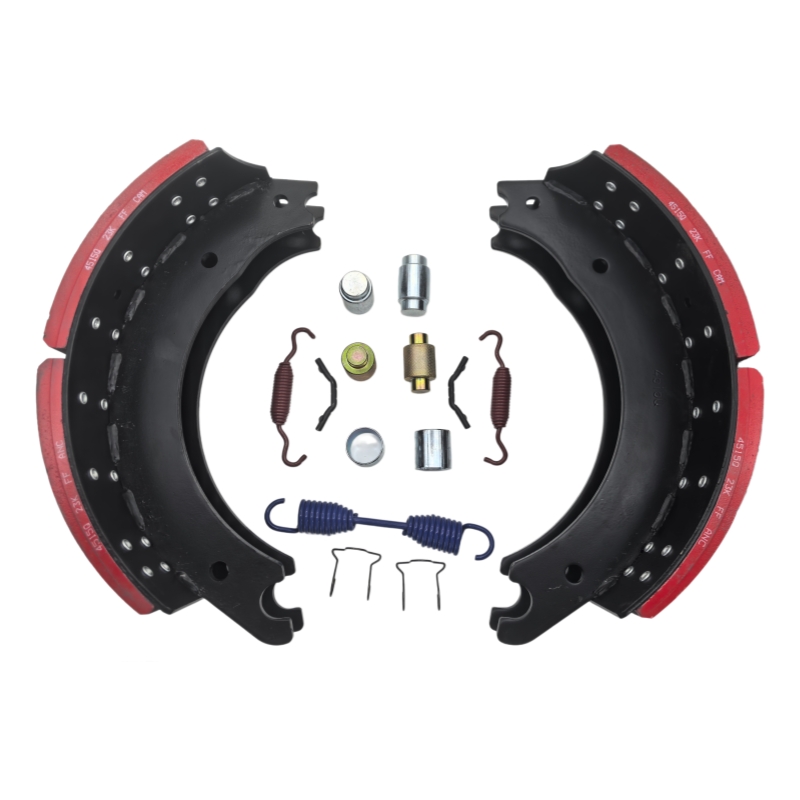
- Two Pre-Riveted Lined Brake Shoes: Professionally fastened with FMVSS-121 certified friction blocks on hydraulically die-coined steel skeletons.
- Complete Wheel-End Hardware Overhaul Set: Factory-matched return springs, retaining hardware, hardened anchor pins, and cam rollers packed directly in the carton.
By specifying complete boxed kits, fleet managers eliminate technician guesswork, prevent the reuse of compromised springs, reduce parts-room stocking friction, and guarantee that every wheel-end returns to service with OEM-grade foundation balance.
Factory-Direct Commercial Foundation Hardware & Shoe Kits
We manufacture and supply North American-specification foundation brake overhaul components directly to heavy-duty parts distributors, commercial buying groups, and fleet maintenance operations. Our product line includes:
- Overhaul Repair Kits: Oil-tempered springs, induction-hardened rollers, and zinc-dichromate corrosion-resistant hardware for 4707, 4515, 4709, 1308E, 4720, SAF SK9, and BPW foundations.
- Complete Lined Shoe Box Kits: Pre-assembled 16.5" x 7", 16.5" x 8-5/8", and 15" x 4" foundation shoe assemblies bundled with matched hardware.
- Private Label & Export Logistics: Custom carton branding, barcoded polybags, laser web marking, and palletized 40HQ containerload shipments direct to North American logistics hubs.
Ensure your maintenance bays and wholesale dealer shelves are equipped for zero-defect wheel-end rebuilds. Contact our commercial OEM supply team today to request product engineering sheets, salt-spray test data, and factory-direct volume pricing.