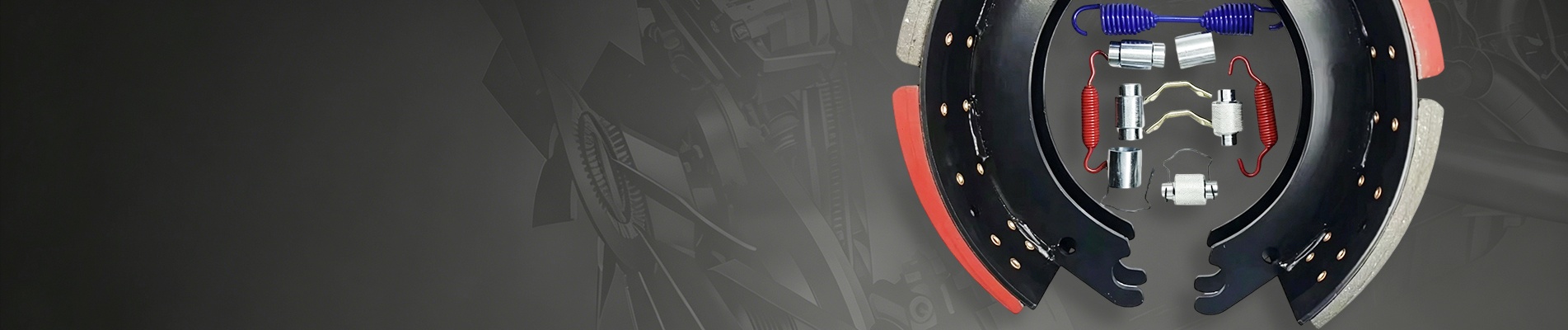
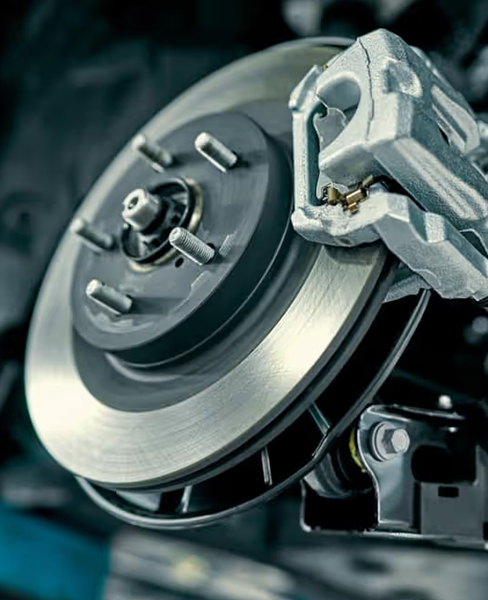
A brake shoe may appear to be nothing more than a simple curved steel component, but in reality, it is one of the most highly stressed parts of a vehicle's braking system. It must withstand thousands of thermal cycles, constant vibration, and immense mechanical loads without bending, cracking, or deforming. Substandard brake shoes not only wear out faster but also cause noise and vibration; in severe cases, they can even lead to brake failure.
As a U.S. Department of Transportation (DOT) registered brake shoe manufacturer, PFZD focuses on two key processes to enhance the strength and durability of its products: quench hardening and multi-pass laser surface texturing. Below is an explanation of these processes and their importance.
Causes of Brake Shoe Failure: Two Common Weak Points
Before discussing solutions, it is essential to understand the problems. Brake shoes typically fail in two ways:
Deformation under load—The brake shoe bends or warps after repeated braking, resulting in uneven contact with the brake drum and reduced braking force.
Fatigue cracking—Micro-cracks form near rivet holes and edges; these cracks eventually propagate, leading to brake shoe fracture.
The root cause of both issues is insufficient toughness in the steel at critical locations.
Process 1: Quench Hardening—Strengthening from Within
Quench hardening is a heat treatment process that alters the internal microstructure of the steel.
PFZD’s process:
The brake shoe is heated in a furnace to a precisely controlled temperature.
It is then rapidly cooled (quenched) in a controlled medium.
This process transforms the steel's microstructure into martensite—a crystal structure characterized by superior hardness and strength.
Real-world advantages:
Higher tensile strength—The brake shoe resists bending even during heavy-duty braking with fully loaded trucks.
Superior fatigue resistance—The brake shoe can withstand hundreds of thousands of braking cycles without cracking. Dimensional stability—reduced deformation means more even wear on the friction lining, thereby extending the service life of the entire brake assembly.
Temperature control is key. Insufficient heating leads to incomplete microstructural transformation of the steel, while overheating makes the steel brittle. At PFZD, temperature is monitored for every batch to ensure consistent quality.
Process 2: Multi-pass laser surface texturing—strength visible to the naked eye
If quenching strengthens the steel from within, laser texturing reinforces it from the outside while imparting specific functional characteristics to the surface.
What is laser texturing?
We use high-precision lasers to engrave a uniform texture pattern onto the brake shoe surface over multiple passes. Each pass deepens and refines the texture, creating a surface with the following properties:
Greater rigidity—the textural geometry acts like microscopic reinforcing ribs, enhancing the surface's resistance to bending and vibration.
Superior bonding—the laser-textured surface provides stronger mechanical interlocking for adhesives and friction linings. This drastically reduces the risk of delamination (where the friction layer peels away from the steel shoe body)—one of the most dangerous failure modes for brake shoes.
Consistent appearance—every brake shoe displays the same crisp, uniform texture pattern. What you see is what you get; the visual appearance reflects the actual strength.
Why use a multi-pass process?
Single-pass laser processing creates only shallow textures that can wear down or flatten over time. Our multi-pass process engraves deeper, more sharply defined textures, ensuring they remain effective throughout the product's entire service life. Although this process is slower and more costly than single-pass texturing, we refuse to cut corners on such a critical, safety-related component.